

Guitar technique · Stretch
Playing guitar with small hands: what really limits your stretches
In short
Small hands limit the maximum reach between two fingers, but far less than people think. Most often, a stretch that fails comes from mechanics (thumb too high, bent wrist, poorly placed elbow), not hand size. The real question is whether the stretch exceeds your actual reach, or whether your hand can reach it but the motion collapses while doing it.
“I have small hands, I’ll never be able to play that.” I heard that sentence dozens of times in lessons. And in the vast majority of cases, the hand wasn’t the problem. Here’s how to tell a real physical limit from a position problem, and what to do in each case.
Physical reach and mechanics: two different problems
When a stretch fails, there are two possible situations. In the first, the stretch really exceeds what your hand can comfortably reach: even relaxed and well placed, your fingers can’t get to the frets. In the second, your hand can reach those frets, but while playing the passage your position degrades: the wrist bends, the thumb creeps up, the shoulder tightens, and the motion slows down.
The second situation is by far the most common. And that’s good news: mechanics can be fixed, while hand size doesn’t change.
Why it’s rarely about hand size
On a guitar neck, the space between frets isn’t constant: each fret is slightly shorter than the previous one as you move up toward the body. The same four-fret stretch therefore asks for much more spread near the nut than at the twelfth fret.
Many exercises and tabs put stretches in the first positions, where they’re the most demanding. A stretch that’s impossible in first position often becomes comfortable a few frets higher. That’s why the RIFFLEX Crash Test transposes its tabs to the area of the neck that suits your hand measurements: to measure your technique, not your anatomy.
Position tweaks that gain you reach
- Thumb: lower it behind the neck, roughly in the middle, rather than wrapping it over the top. This position opens the space between your fingers.
- Wrist: keep it as straight as possible. A sharply bent wrist shortens your fingers and creates tension.
- Elbow: bring it slightly closer to your body so your fingers face the strings instead of coming at an angle.
- Neck angle: tilting the headstock up a little brings the first frets closer and relieves the wrist.
- Guitar height: slung too low, the guitar forces your wrist to bend. A shorter strap often changes everything.
Adapt the fingering instead of forcing it
A stretch doesn’t have to be played exactly as written. You can often shift your hand slightly during the passage (a small slide of the thumb), spread the stretch differently across your fingers, or play the same pattern higher up the neck.
On the instrument side, scale length matters too: a short-scale guitar (around 24.75 in / 628 mm, like many Gibson-style models) has slightly closer frets than a long scale (around 25.5 in / 648 mm, like many Fender-style models).
Working on stretches without getting hurt
The spread between your fingers improves over time, but it has to be trained gently. Start in the higher frets, where the stretch is smaller, and work your way down toward the nut over the weeks. Play slowly and stay relaxed: a stretch held by force isn’t a stretch you control.
If you feel pain in your hand, wrist or forearm, stop. A stretch should never hurt.
Measure instead of guessing
The RIFFLEX report asks exactly this question: “Which gap strays furthest from your physical potential?”. It compares the stretch each fingering demands with your hand’s measured reach for the same finger pair. If a stretch stays within your reach but your tempo collapses, it’s your mechanics that need work, not your hand that’s to blame.
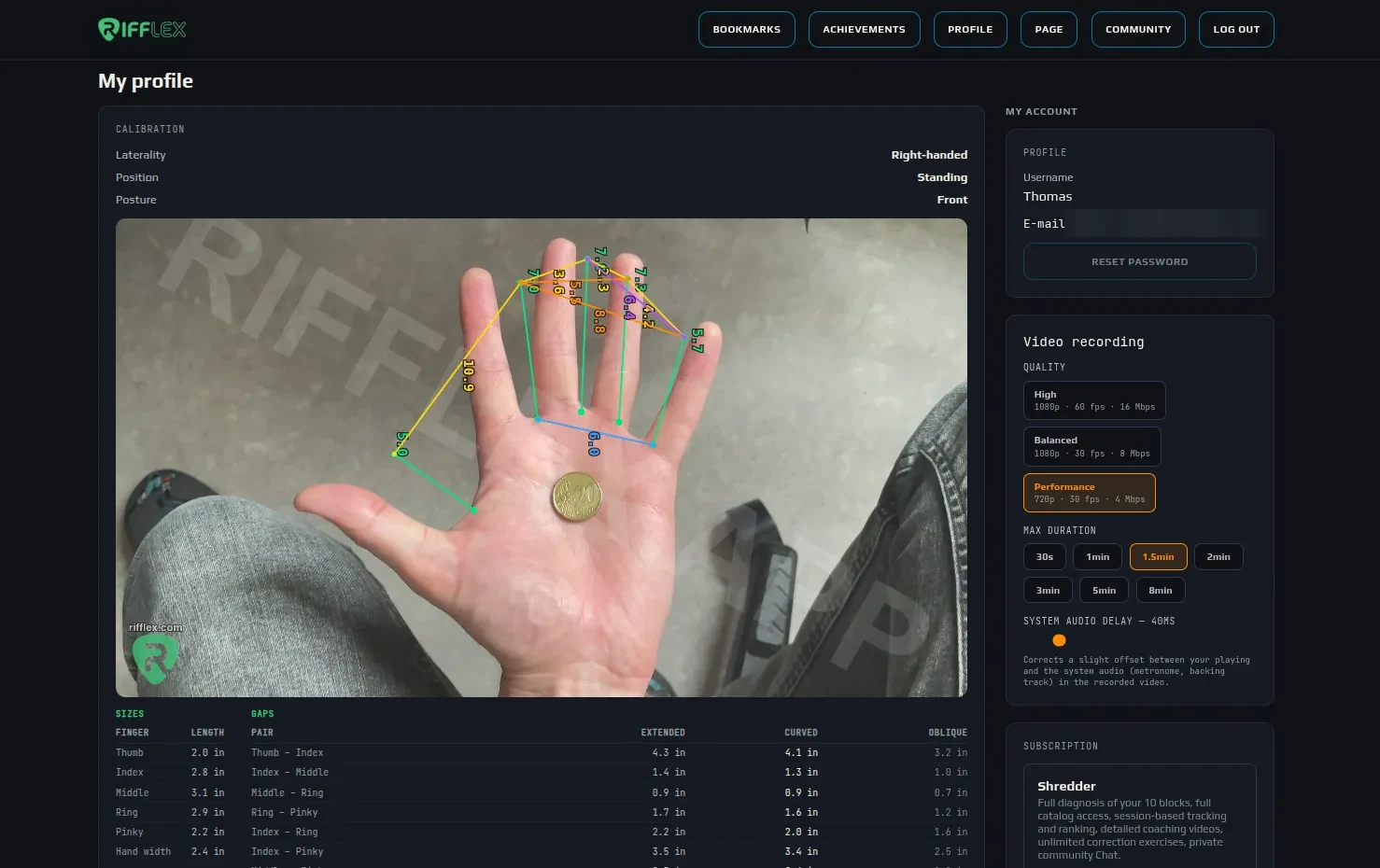
A hand measured rather than guessed: the length of each finger and the gap between each pair, stretched, curled and slanted, from a single photo.
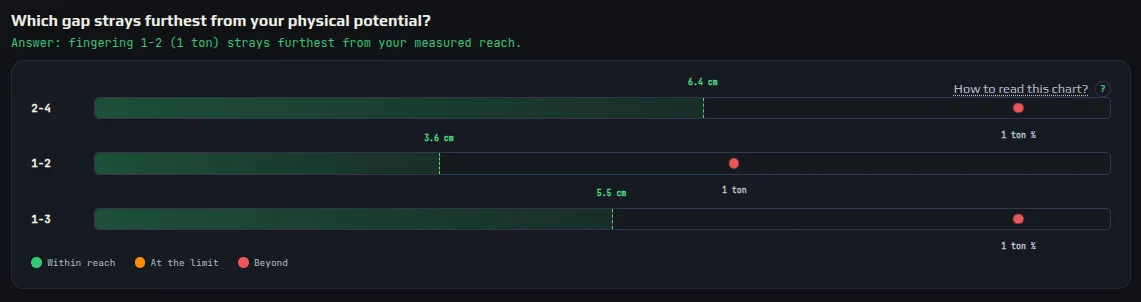
Those measurements crossed with your playing: for each fingering, the gap your hand reaches against the one the exercise asks for.
Frequently asked questions
Are my hands too small to play guitar?
Almost never. Many guitarists with small hands play demanding techniques. Size mostly limits very wide stretches near the nut, and good positioning makes up for much of the difference.
Should I buy a smaller guitar?
Not necessarily. A short scale brings the frets a little closer and can help, but fixing your thumb, wrist and guitar position usually does more.
Can I increase my finger spread?
Yes, to some extent, with gradual and relaxed practice, starting in the higher frets. Never force it and never practice through pain.