

Guitar technique · Fingerings
Ring and pinky fingers: why they move together, and how to make them independent
In short
Your ring and pinky fingers are linked by anatomy: their extensor tendons are connected on the back of the hand, and the ring finger has no extensor muscle of its own. When one moves, the other tends to follow. You can’t remove that link, but you can teach your brain to control it better, with slow, relaxed, regular exercises on the 3–4 pair.
It’s one of the most common complaints among guitarists: the pinky lifts on its own when the ring finger moves, 3–4 trills are uneven, and any pattern using those two fingers suddenly slows down. It isn’t laziness or a lack of talent: it’s first of all a matter of anatomy.
What links the ring and pinky fingers
Your fingers are extended (lifted) by one main forearm muscle, the extensor digitorum, which sends a tendon to each finger. On the back of the hand, those tendons are joined by small fibrous bands, the intertendinous connections. They’re especially strong around the ring finger.
The index and the pinky each also have their own extensor muscle, which gives them some autonomy. The ring finger doesn’t: it relies only on the shared extensor, tied to its neighbors. On the flexing side, the middle, ring and pinky fingers also largely share the same deep flexor muscle.
The result: lifting or lowering the ring finger alone requires your brain to actively hold back its neighbors. It’s doable, but it has to be learned.
The symptoms on guitar
- Trills and legato on the 3–4 pair are clearly slower than on the 1–2 pair.
- The pinky flies high above the neck when the ring finger plays, then takes time to come back.
- Notes played by the ring finger or pinky are weaker or less clear than the others.
- Four-finger patterns fall apart right where 3 and 4 have to follow each other.
How to tell if it’s really your weak spot
The right test is to compare, with a metronome, the same pattern played with different finger pairs: 1–2, 1–3, 1–4, 3–4. Note the clean tempo of each. If the 3–4 pair drops off clearly while the others keep up, the ring–pinky link is very likely the cause.
If instead the 1–4 pair drops, the problem is more likely the spread between index and pinky: a different difficulty, worked on differently. Making that distinction is why the RIFFLEX report answers the question “Which finger combination limits you the most?” by comparing your fingerings against each other.
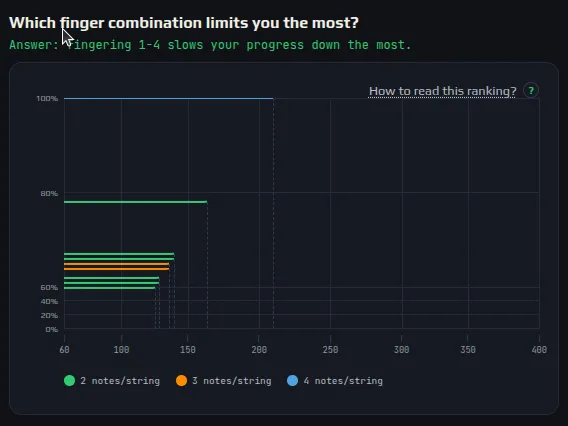
Comparing your fingerings is enough to settle it: if the ones that pair the ring and pinky fingers sit at the bottom of the ranking, that really is your weak spot.
Exercises to build independence
The goal isn’t to stretch anything but to improve control: teaching your brain to move one finger without dragging its neighbor. That comes from slowness and precision, not force.
- Slow 3–4 trills on one string, with a metronome, keeping fingers close to the strings. Raise the tempo in small steps only while the motion stays relaxed.
- 3–4 trills with the index and middle fingers resting on the string: they act as an anchor and stop the hand from compensating.
- Rotate the pairs: play 1–2, then 3–4, then 1–3, then 2–4, so the weak pair is never drilled alone for too long.
- Minimal height: watch your pinky and aim to keep it a few millimeters from the string when it isn’t playing.
- Short, regular sets: a few minutes a day beat one long session that ends in tension.
Mistakes to avoid
Forcing it: the link between the tendons is a physical structure; it doesn’t “break” with practice. Trying to force it creates tension, and tension slows everything down. If pain appears, stop and see a health professional.
Avoiding the pinky: many guitarists work around the problem by playing everything with three fingers. It works for a while, then it closes the door on many fingerings.
Practicing too fast: above your clean tempo, the pinky starts following the ring finger again, and you train exactly the flaw you want to fix.
Frequently asked questions
Can the ring finger become fully independent?
Not fully: the link between the tendons is anatomical and stays. But control improves a lot with regular practice, to the point where the difference can’t be heard in your playing.
Do all guitarists have this problem?
Everyone has this anatomical link, with differences from person to person. For some it slows the 3–4 pair a lot; for others, barely. Only comparing your fingerings tells you whether it’s your weak spot.
Should I avoid using my pinky?
No. Working around the pinky limits your fingerings in the long run. It’s better to train it slowly and regularly.