

Guitar technique
Why your guitar technique plateaus even though you practice
In short
Technique rarely plateaus from a lack of practice. Most often one specific motion is stuck (a finger pair, a crossing direction, a stretch) and general practice misses it. To break through, isolate that motion by changing only one difficulty at a time, then practice it slowly and consistently while tracking your tempos.
You play every day, you do your exercises, and the same passages have been falling apart for months. It’s one of the most frustrating situations for a guitarist, and one of the least understood. In 25 years of teaching I’ve seen hundreds of students go through it. Almost every time, the cause wasn’t where they were looking.
A plateau doesn’t mean you’ve hit your limits
A plateau isn’t a ceiling. When you start out, everything improves at once: every hour of practice helps your fretting hand, your picking hand, your reading and your timing. Then comes a point where that overall progress slows down. What holds you back is no longer “guitar” in general, but a handful of specific motions that didn’t keep up.
The trouble is that usual practice (playing songs, running through varied exercises) dilutes those weak motions among everything you already master. You spend 90% of your time on what works, and the weak spot barely gets a few repetitions.
Cause #1: you practice a technique, not a motion
People say “my legato isn’t clean” or “I get stuck at speed”. But a technique is made of several very different motions. Legato, for example, mixes hammer-ons and pull-offs, on different finger pairs, on one string or across strings, with or without a stretch.
It’s rare for all of it to be weak. Far more often, a single combination fails: the ring–pinky pair, the pull-off toward a lower string, the stretch between index and pinky. Until you know which one, you’re practicing the whole technique to fix one of its parts.
Cause #2: you practice without measuring
The feeling of progress is misleading. On a good day everything feels easy; on a tired day everything feels lost. Without a record, you can’t tell whether an exercise is moving up, stalling or slipping.
The simplest and most honest measure is your clean tempo: the fastest BPM at which you play an exercise without mistakes, with clear and even notes. Logged every session, it turns an impression into a trend. And comparing the tempos of several closely related exercises is how the failing motion shows up.
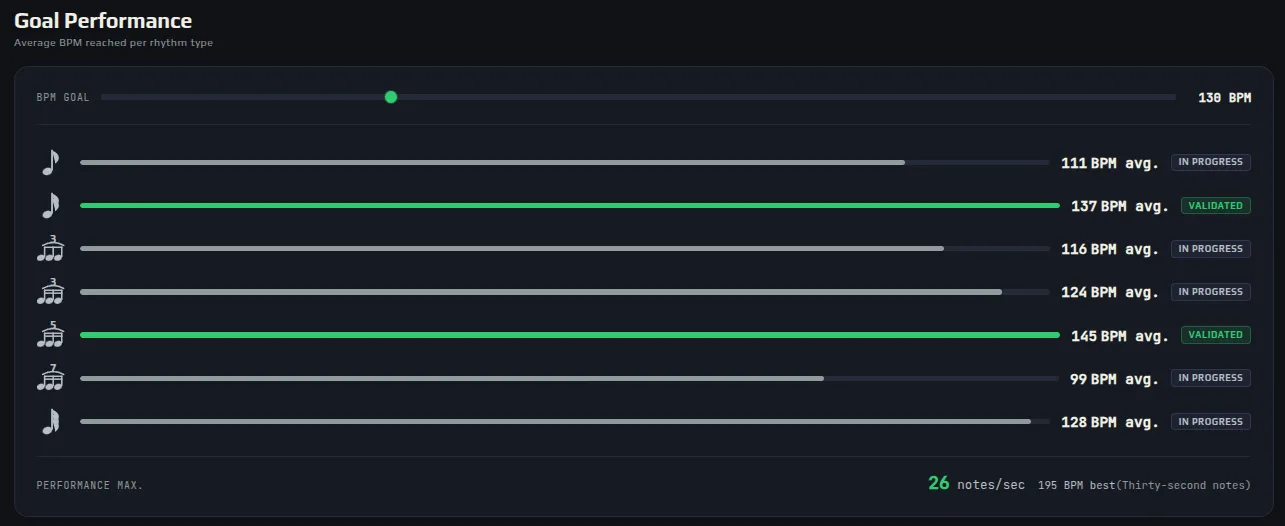
With a measurement, plateauing becomes readable: your average tempo per rhythm, against the target you set yourself.
Cause #3: you push the speed too early
Playing above your clean tempo trains the motion… along with its flaws. Fingers tense up, muscles that should relax between notes stay contracted, and that tension becomes part of the movement. The more you repeat that tense motion, the more automatic it gets.
Speed is a result, not an exercise. It comes from a clean, relaxed motion repeated often enough to become automatic, then pushed up in small tempo steps.
Cause #4: stress narrows your focus
On a hard passage, many guitarists stare at the neck and tense up without noticing. That focusing reflex has a cost: your eyes stop looking ahead to the next position, tension builds in the shoulder and forearm, and the motion loses its flow. The passage gets harder, which raises the stress… and the loop feeds itself.
Here the fix isn’t muscular but attentional: slow down, soften your gaze, breathe, and rebuild the passage at a tempo where it stays comfortable.
Cause #5: your practice is irregular
For technique, consistency beats intensity. The brain consolidates a motor skill between sessions, notably during sleep. Twenty minutes every day builds a motion far more solidly than three hours on Sunday, after which fatigue ends up making you repeat a degraded motion.
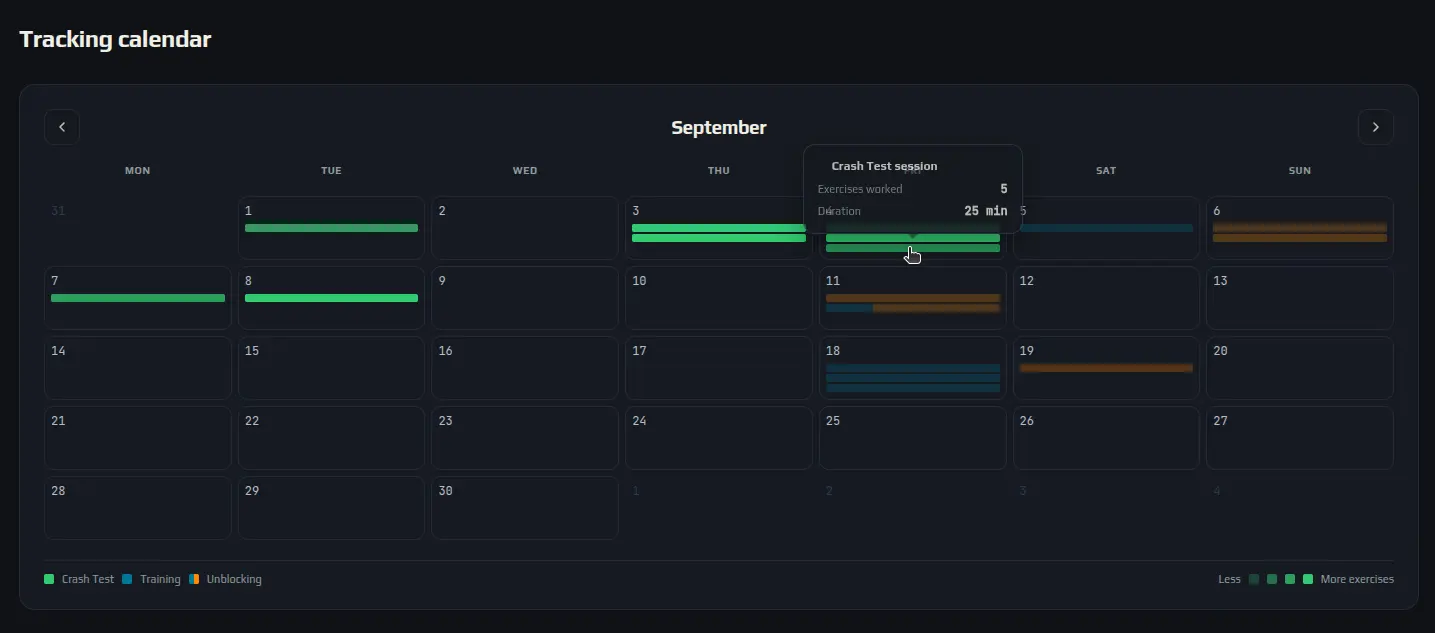
Consistency shows at a glance: each bar is a session. Empty weeks often explain a tempo that won’t move.
How to find the motion holding you back
The principle is simple: change only one difficulty at a time, and watch where the tempo drops. If you play a clean pattern on one string, then the same pattern with a wider stretch, then the same pattern across strings, the difficulty that makes your tempo drop is the one blocking you. Not the others.
It’s exactly how a teacher reasons when watching a student: remove variables until the problem shows up on its own. Doing it alone takes discipline and careful tempo notes, but it’s the only way to know where to put your energy.
- Pick the passage that breaks down and split it into its basic motions.
- Play each motion on its own with a metronome and note your clean tempo.
- Add a single difficulty at a time (stretch, string change, shift, skip).
- Find the step where the tempo clearly drops: that’s your motion to work on.
- Practice that motion slowly and consistently, and re-measure it every week.
Frequently asked questions
Does a plateau mean I’ve reached my limits?
Almost never. A plateau usually means overall progress has slowed and a few specific motions didn’t keep up. Once those motions are identified and worked on, progress resumes.
Should I practice longer to get past a plateau?
Not necessarily. Practicing longer on the same exercises mostly reinforces what you already master. Shorter, regular sessions focused on the weak motion work better.
How do I know if I’m really improving?
Log your clean tempo on the same exercises, session after session. A trend over several weeks is far more reliable than how a single session feels.