

Guitar technique · Stretch
Finger stretches on guitar: measuring and reducing what they cost you
In short
A stretch (a gap wider than the natural spacing between two fingers) almost always costs some speed. The right question isn’t “can I do it?” but “how much do I lose?”. Compare the same fingering played with the natural gap, then a whole step, then a step and a half: if the loss is big while the stretch stays within your reach, it’s your hand mechanics that need fixing.
Stretches are part of every modern technique: wide-interval legato, three- and four-notes-per-string scales, open arpeggios. Many guitarists can play them… slowly. The day they need to play them fast, everything tenses up.
What a stretch is
Between two neighboring fingers, the natural gap is a half step: one fret. A stretch means forcing a wider gap on the same finger pair, for example a whole step (two frets) or a step and a half (three frets) between index and middle finger. You get a double or triple stretch when several forced gaps stack up in the same position.
Measuring the cost of a stretch
Play a fingering with the natural gap and note your clean tempo: that’s your reference, 100%. Play the same fingering with a whole-step gap, then a step and a half, always with a metronome. Your tempo as a percentage of the reference is the cost of the stretch.
A moderate cost is normal. A cost that collapses at the first forced gap points to a position problem rather than a hand limit. It’s the question the RIFFLEX report asks: “Which stretch costs you the most speed compared to playing without it?”.
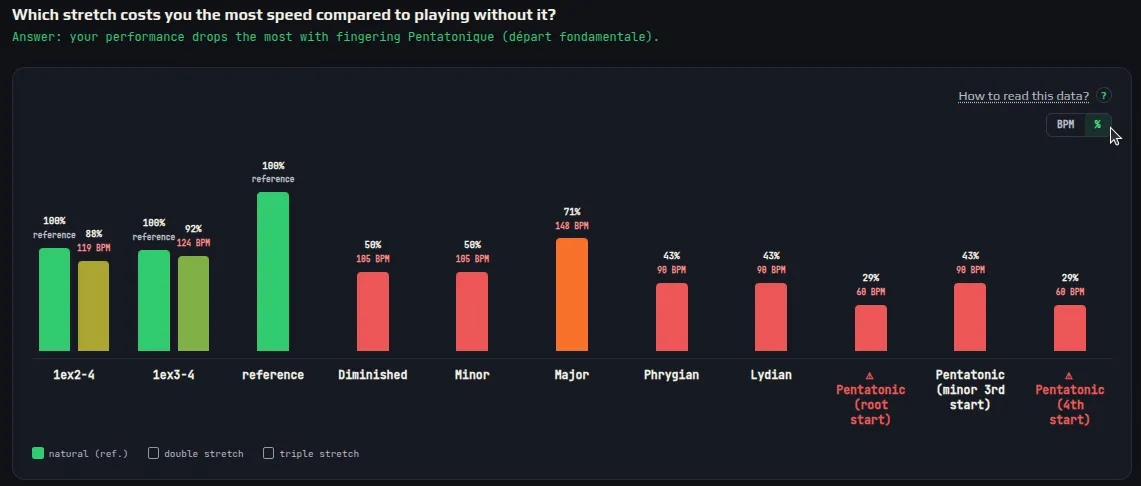
The cost of a stretch, measured: the tempo of each stretched fingering compared with your playing without one, in BPM and as a percentage lost.
Why a stretch slows you down
- The hand opens to its maximum and loses some freedom of movement: fingers strike from a less natural position.
- The thumb often creeps over the top of the neck, which reduces the spread instead of increasing it.
- The wrist bends to compensate, and tension spreads into the forearm.
- The effort of holding the gap makes you forget to relax between notes.
Working on stretches effectively
- Start in the higher frets, where gaps are smaller, then work your way down toward the nut.
- Place your thumb behind the neck, fairly low, and keep your wrist as straight as possible.
- Practice the gap without speed first: place, relax, place again, until the motion feels relaxed.
- Widen the gap in steps (a whole step, then a step and a half), and only move on when the speed loss is small.
- Stop at the slightest pain: a stretch should never hurt.
Stretches and hand size
A stretch can exceed your real reach, but that’s less common than people think. Most failing stretches are physically reachable and collapse because of position. The article on small hands explains how to tell the difference and which tweaks gain you reach.
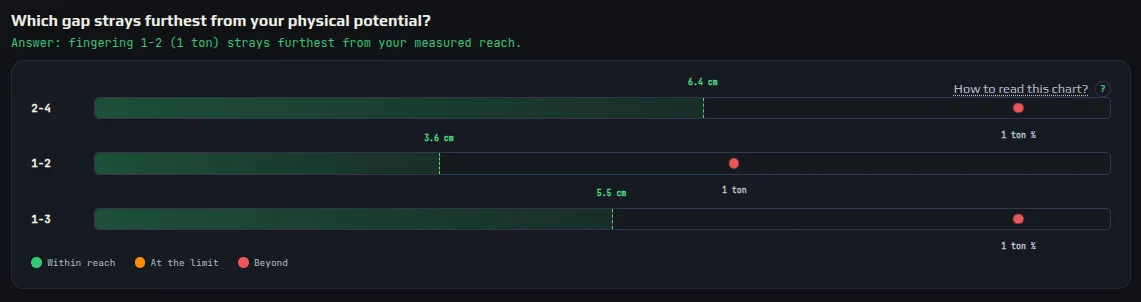
The gap your hand reaches (green bar, measured by the scan) against the gap the exercise asks for (the dot). When the dot falls outside the bar, reach is the limit, not technique.
Frequently asked questions
Is it normal to lose speed when stretching?
Yes, a slight loss is normal. What should worry you is a big loss at the very first forced gap while the stretch is still reachable: that’s usually a position problem.
Should I stretch my fingers before playing?
A gentle warm-up playing slowly is enough. Forced finger stretches are useless, even risky: flexibility comes from playing relaxed, gradually.
Where on the neck should I start working on stretches?
In the higher frets, where frets are shorter. Then move down toward the nut over the weeks.