

Guitar technique · Fingerings
Which finger slows you down on guitar? Finding the combination that limits you
In short
It’s almost never a single finger that slows you down, but a combination of fingers. To find it, play the same pattern with a metronome using each pair (1–2, 1–3, 1–4, 2–3, 2–4, 3–4), note each pair’s clean tempo, and compare them with your best pair. The one that loses the most speed is your weak fingering: that’s what to work on first.
“My pinky is too weak.” It’s often the first diagnosis guitarists give themselves. But in lessons, once you actually compare fingerings, the answer is rarely that simple: a pinky can be perfectly comfortable with the index and really struggle with the ring finger. What matters is the combination.
Why think in finger pairs
A hammer-on or pull-off always involves two fingers: the one holding the starting note and the one striking or pulling the string. The difficulty depends on both. The 1–2 pair benefits from two close, independent fingers; the 3–4 pair runs into the anatomical link between ring and pinky; the 1–4 pair asks for the widest spread of the hand.
That’s why a “pinky exercise” can change nothing: if it works the 1–4 pair while your problem is the 3–4 pair, it misses the point.
The test: compare your fingerings against each other
Pick a simple legato pattern on one string, always in the same position. Play it with each finger pair in turn, with a metronome, and note for each the fastest tempo at which the notes stay clear and even.
Take your best pair as the reference (100%) and express the others as a percentage of it. A pair at 95% isn’t a problem. A pair that falls clearly below the others is.
That’s exactly what the fingering ranking in the RIFFLEX report does, answering the question “Which finger combination limits you the most?”.
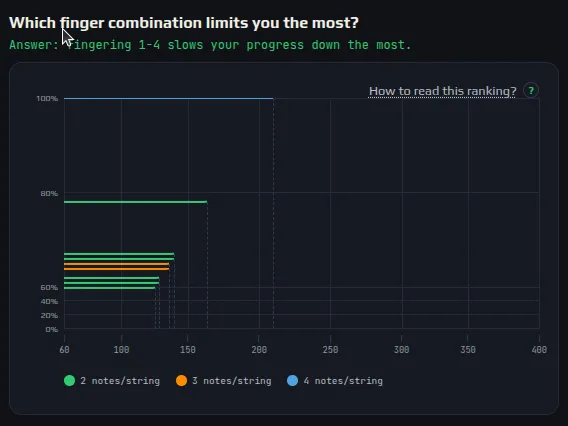
This test, as RIFFLEX shows it in the report: each fingering placed by the tempo reached. Here the answer is clear: 1-4 is the one slowing progress the most.
The most common profiles
- The 3–4 pair drops off: the link between ring and pinky holds back their alternating motion. This is the most common case.
- The 1–4 pair drops off: it’s the hand’s maximum spread that costs you, more than the pinky itself.
- The 1–3 pair drops off without the pinky involved: the often-underestimated gap between index and ring finger is at play.
- Three- or four-finger fingerings drop off: the difficulty comes from sequencing and coordination, not from one particular pair.
How to work on your weak fingering
Once the weak pair is identified, give it real room in your session, without drilling it alone for too long.
To find material for it, the RIFFLEX training library has filters: the Fingering filter shows only the exercises that use that pair (1-4, 3-4…), and the Targeted block filter picks the exercises built for fingerings. You can cross them with technique and rhythm.
- Start each session with a few minutes on the weak pair, while your hand is fresh.
- Alternate with a strong pair to keep the motion relaxed and remember what “easy” feels like.
- Stay below your clean tempo: a fast but tense motion locks the flaw in instead of fixing it.
- Re-measure the same pattern with every pair each week: the gap with your best pair should shrink.
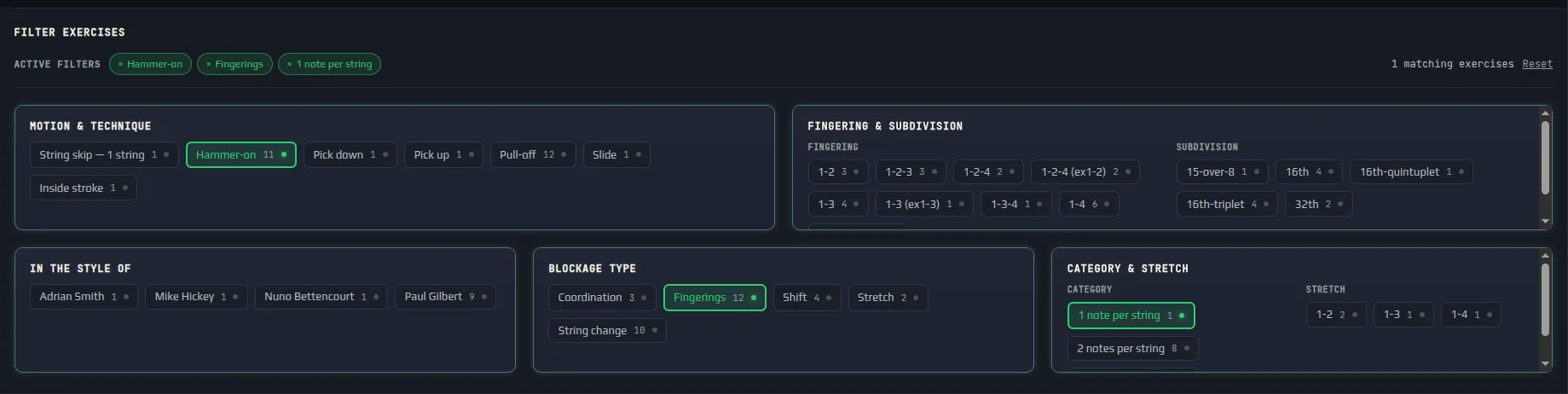
The training library filters: pick your weak pair under Fingering, and the counter tells you how many exercises work on it.
Frequently asked questions
What is the weakest finger on guitar?
There’s no universal answer. The pinky often gets the blame, but difficulty depends mostly on the finger pair: many guitarists are comfortable with 1–4 and struggle with 3–4, or the other way round.
Should I build finger strength?
Rarely. Legato speed depends more on control, relaxation and accuracy than on strength. A “weak” finger usually lacks coordination, not muscle.
How many finger pairs should I test?
The six possible pairs (1–2, 1–3, 1–4, 2–3, 2–4, 3–4) give the full picture. At minimum, compare 1–2, 1–4 and 3–4, which reveal the most common profiles.