

Guitar technique · Fingerings
Legato with 2, 3 or 4 notes per string: what playing density changes
In short
The number of notes you play on a string before changing (the density) deeply changes the motion. At 2 notes per string, the difficulty lies in frequent string changes; at 3, in sequencing three fingers and often a stretch; at 4, in the independence of all four fingers and stretches. The rhythm you choose (eighths, triplets, sixteenths) combines with that density and can make a pattern fall apart on its own.
Legato scales and patterns are often organized by notes per string. We switch from one to another without thinking, yet each uses the hand very differently. Knowing which density holds you back lets you target your practice.
2 notes per string: string changes up front
With only two notes per string, the hand changes strings very often. The legato motion itself is simple (one finger pair), but every crossing is a chance to lose speed or volume. It’s the density that best reveals string-change difficulties.
3 notes per string: sequencing and stretch
Three notes per string is the basis of many fast patterns and of “three-notes-per-string” scales. Three fingers follow each other on the same string, often with a wider gap between two of them. Triplet rhythm fits it naturally: each string lands on a beat.
4 notes per string: independence and stretches
Four notes per string use all four fingers, often with stretches. It’s the density where finger independence (especially ring and pinky) and hand reach weigh the most. It also allows very recognizable fingering shapes, like tetrachords (groups of four notes from a scale).
Rhythm, a difficulty of its own
The same pattern doesn’t behave the same in eighths, triplets, sixteenths or quintuplets. When the rhythmic grouping doesn’t match the number of notes per string (for example 3 notes per string played as sixteenths), string changes no longer land on the beat, and the sequencing gets harder.
That’s why the RIFFLEX report crosses motion with rhythm to show where your motion falls apart, and compares your performance across playing densities.
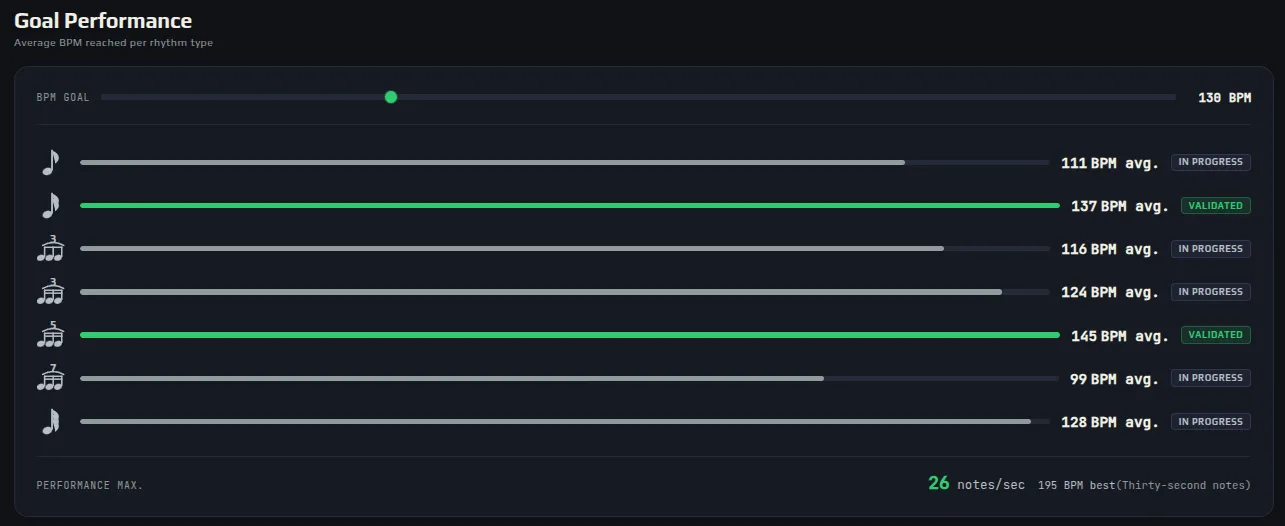
Rhythm changes everything: the same work gives a different average tempo in eighths, triplets or quintuplets. Here, only two rhythms reach the target.
How to practice
- Compare the same motion at 2, 3 and then 4 notes per string, at the same reference tempo, to find the density that holds you back.
- For each density, try several rhythms: the one that makes the pattern fall apart often points to a timing problem at the string changes.
- Start with the rhythm that “fits” (triplets at 3 notes per string, sixteenths at 4), then move on to the offset combinations.
Frequently asked questions
Are three-notes-per-string scales easier in legato?
They suit legato very well, since each string needs one pick stroke followed by two slurred notes. They do, however, require a regular stretch between two fingers.
Why does my pattern fall apart in sixteenths but not in triplets?
If your pattern has 3 notes per string, triplets make each string change land on a beat. In sixteenths that anchor disappears and the sequencing gets harder.
Which density should I work on first?
The one where your tempo drops the most compared with the others. Comparing them at the same reference tempo is the only way to know.