

Guitar technique · String change
Legato string changes: why you lose speed when crossing to the next string
In short
In legato, the speed you lose at a string change depends mostly on the finger pair doing the crossing (which finger leaves the starting string, which finger lands on the next one) and on the direction, toward the low or the high strings. Compare the same fingering on one string and then across strings: the pair and direction that lose the most are the ones to work on.
On a single string your legato flows. As soon as you move to the next string it starts to hiccup: a weaker note, a slight delay, some stray noise. The string change is one of the most underestimated moments in legato.
It’s not the fingering, it’s the transition
Two exercises can use exactly the same fingering on each string and still be completely different motions at the crossing. What matters is the pair of fingers doing the crossing: the finger leaving the starting string and the one landing on the next. Going from pinky to index (4→1) has nothing in common with going from index to ring finger (1→3).
It’s that pair, not each string’s fingering on its own, that the RIFFLEX report highlights with the question “Which finger duo has the most trouble changing strings, and in which direction?”.
Toward the low or the high strings
The direction changes the motion. Moving toward the high strings, the finger landing on the new string often has to sound it alone, without the pick: that’s the hammer-on from nowhere. Moving toward the low strings, it’s often a pull-off that has to carry on onto the new string, with a finger that must already be in place.
Many guitarists have one direction that’s clearly weaker, often the descending pull-off.
Measuring the loss at the crossing
Play a fingering on one string and note your clean tempo: that’s your reference. Play the same fingering across strings, in one direction then the other. The percentage of tempo lost is the cost of the string change for that transition. Repeat with several finger pairs: the transition that loses the most is your weak spot.
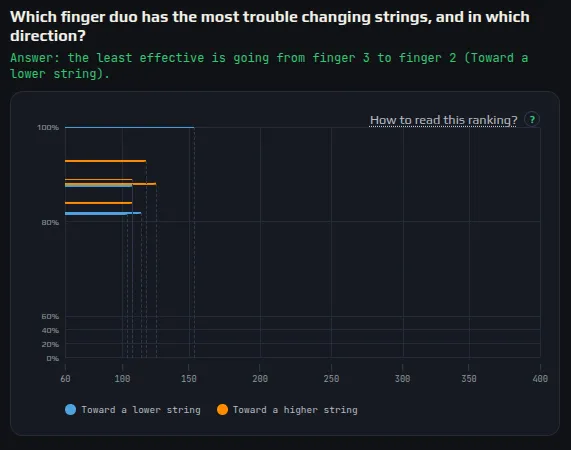
The loss when crossing, finger pair by finger pair and in both directions: blue toward a lower string, orange toward a higher one.
Targeted exercises
- Anticipation: get the landing finger ready above the new string before you’ve finished the starting string.
- Hammer-on from nowhere: practice the strike alone on the new string until it matches the volume of a picked note.
- Muting: the string you leave should stop cleanly, without ringing under the next one.
- Isolate the weak pair: loop only the two notes of the crossing, with a slow metronome, then put the pattern back together.
Frequently asked questions
Why does my legato lose volume when I change strings?
Often because the first note on the new string is a hammer-on from nowhere, which needs a firmer strike than a regular hammer-on. Practice it alone until it matches the volume of a picked note.
Should I pick at every string change?
That’s a style choice. In pure legato, the fretting hand sounds the new string alone; in hybrid playing, the pick restarts each string. Both are worth practicing, but diagnosing pure legato shows your fretting hand’s real autonomy.
Are string changes harder toward the low or the high strings?
It depends on the player and the finger pair. Many struggle more going down toward the low strings with pull-offs, but only comparing both directions tells you which one holds you back.