

Guitar technique
How to measure your guitar technique: what can really be measured
In short
Guitar technique can’t be reduced to a level grade. What you can measure are precise facts: the clean speed you reach on an exercise, the gap between your best and worst fingering (independence), the number of attempts you need (consistency), the speed you keep when a difficulty is added (endurance) and the share of stretches that stay within your hand’s reach.
“What’s my level?” is the wrong question. It mixes musicianship, repertoire, ear, technique… and doesn’t tell you what to work on. To improve your technique, you need smaller, more precise measures you can compare from one session to the next.
Clean speed
The fastest tempo at which you play an exercise without mistakes, with clear and even notes. It’s the basic measure. On its own it says little; compared across closely related exercises it becomes valuable. The RIFFLEX report compares it with an expert reference to place your peak speed.
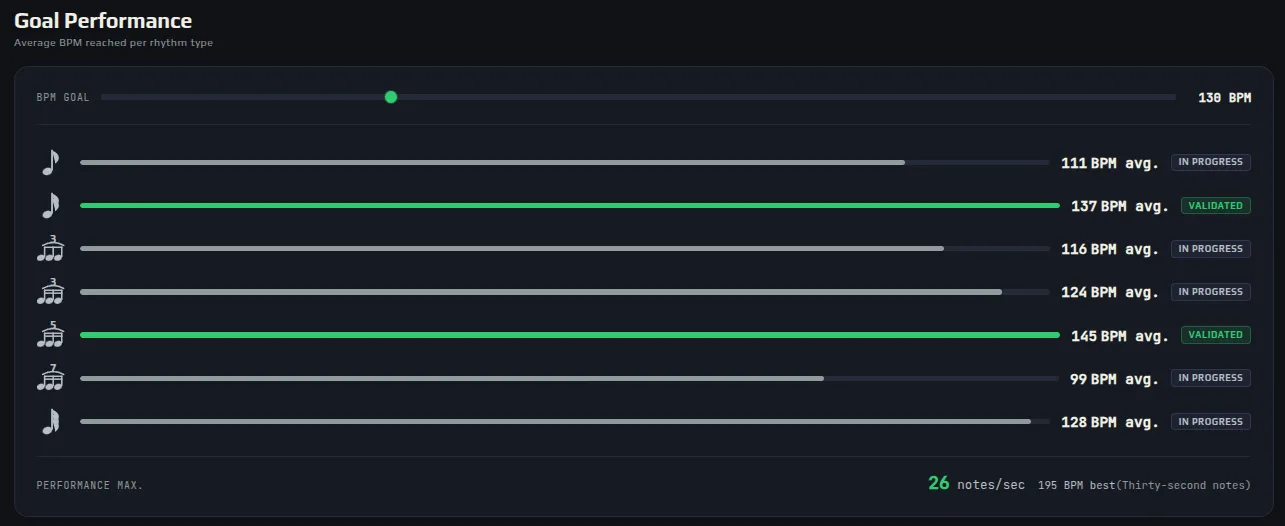
Clean speed, rhythm by rhythm: your average tempo against the target, and your record turned into notes per second to compare different rhythms.
Finger independence
The gap between your best and your worst fingering on the same pattern. The smaller it is, the more independent your fingers. A fast guitarist can have poor independence: fast on one finger pair and much slower on another.
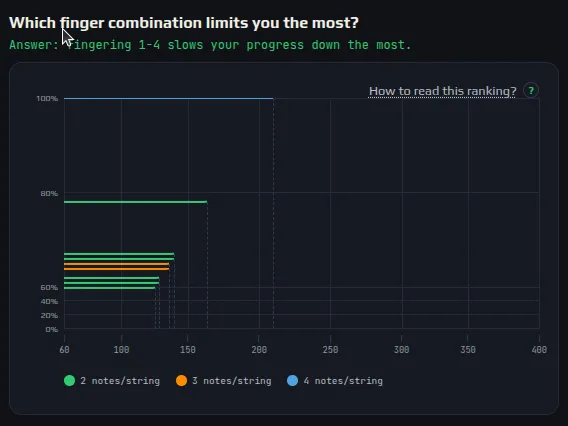
Independence shows in the gap between the bars: your best fingering at the top, your worst at the bottom. The closer they are, the more independent your fingers.
Consistency
The average number of attempts you need to nail an exercise. It measures how stable the motion is, regardless of speed: an exercise nailed on the first try is learned; one that takes five attempts isn’t yet, even if the fifth is fast.
Endurance
Does your speed hold when a difficulty is added? You measure it by comparing the same fingering with no constraint, then with a forced stretch, a string change or a shift. The less you lose, the sturdier your motion.
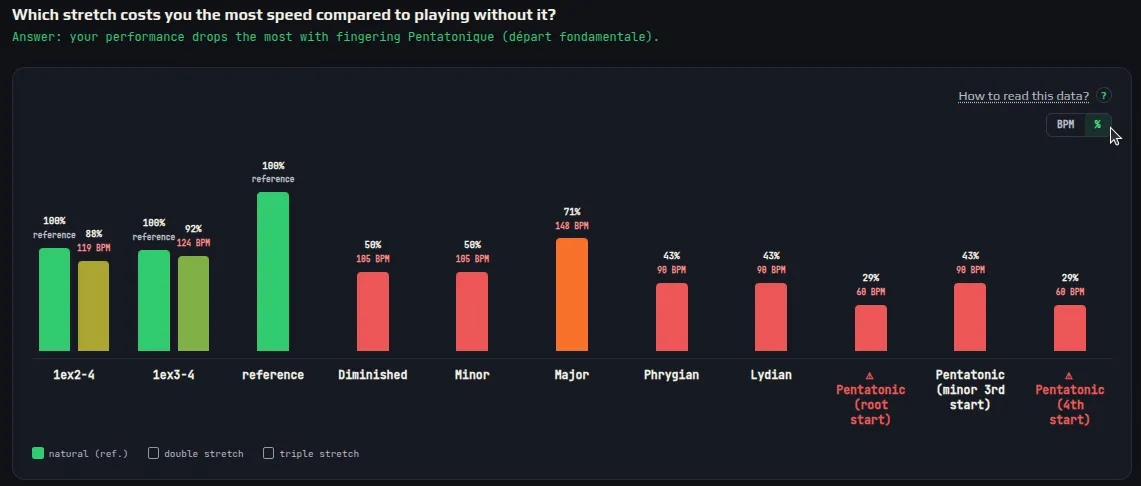
Endurance, measured on stretches: each fingering compared with the same playing without a forced gap, with the percentage of speed lost.
Anatomical margin
The share of required stretches that stay within your hand’s measured reach. It separates two very different situations: a stretch beyond your physical reach, and a reachable stretch where your mechanics give way.
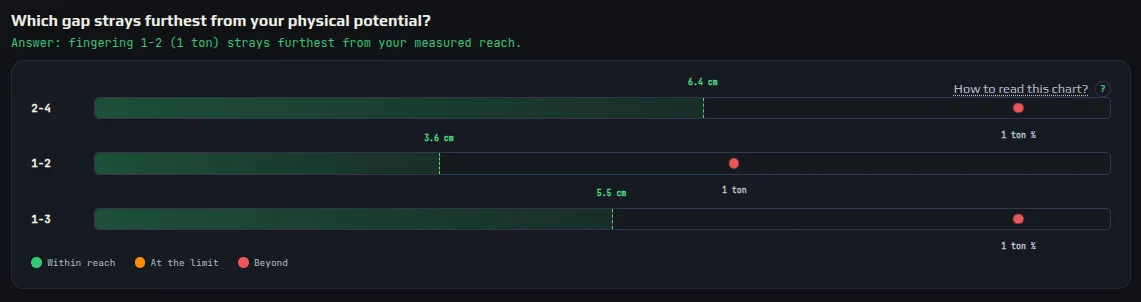
Anatomical margin: for each fingering, the gap your hand reaches (green bar) against the one the exercise asks for (the dot).
What you need to measure properly
- A metronome and identical exercises from session to session.
- A clear success criterion: the note is heard distinctly, without buzz, at the same volume as the picked note.
- Only one difficulty changing at a time between two exercises you compare.
- A history: a single measure is worthless, a trend over several weeks says everything.
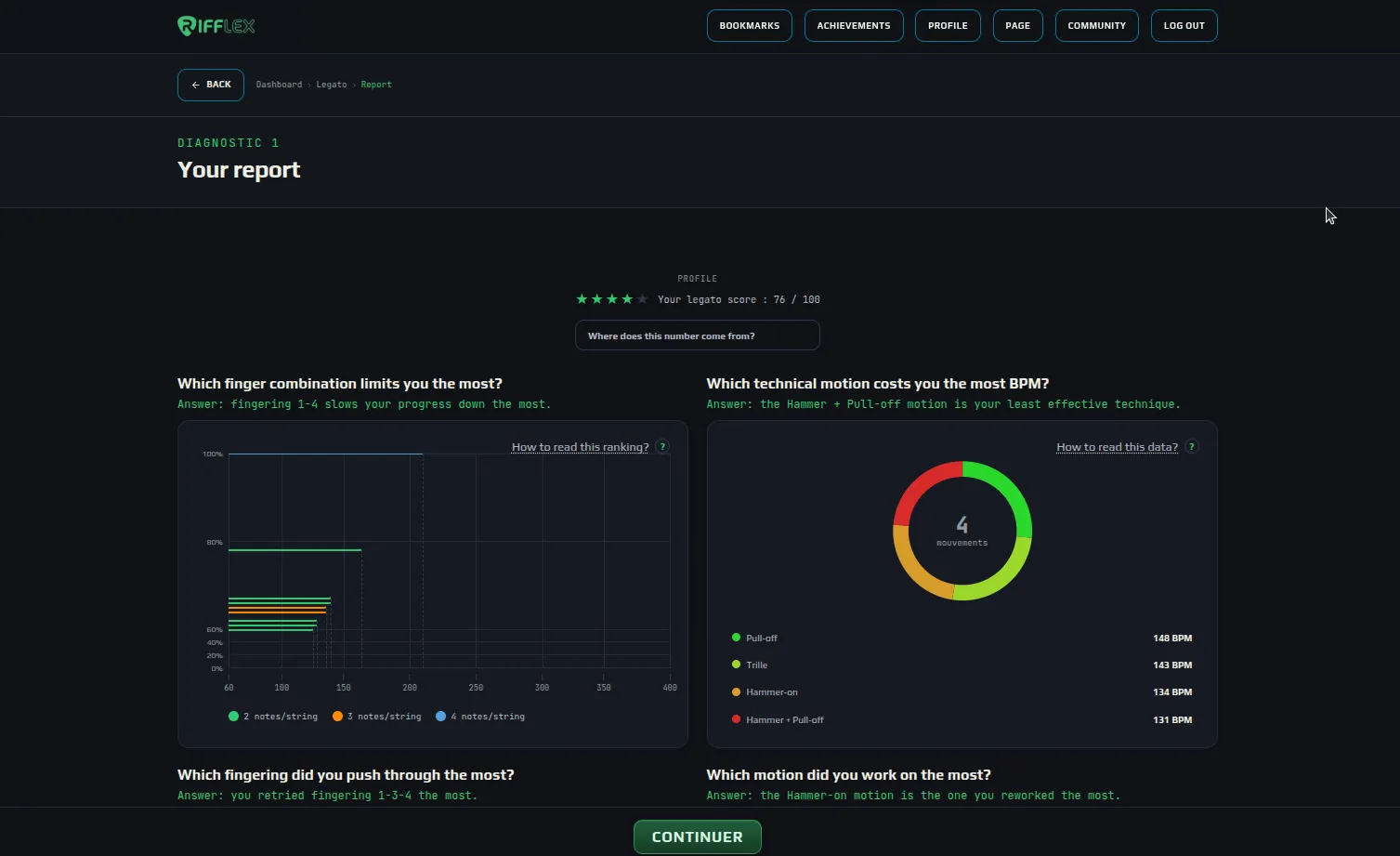
These criteria brought together in a report: a score out of 100 that breaks down into speed, independence, consistency, endurance and anatomical margin, then one chart per question.
Frequently asked questions
Can an app measure my guitar level?
It doesn’t measure an overall “level”, which mixes too many things. It can, however, measure precise facts (tempos, attempts, stretches) and compare them to pinpoint what holds you back.
Is speed enough to assess technique?
No. Speed alone doesn’t tell you whether the motion is stable, whether every finger keeps up, or what happens when a difficulty is added. It has to be combined with consistency, independence and endurance.
How often should I measure myself?
Often enough to see a trend, without obsessing over it: re-measuring the same exercises every week is a good pace.